


Sign in to rate this tool.
Overview
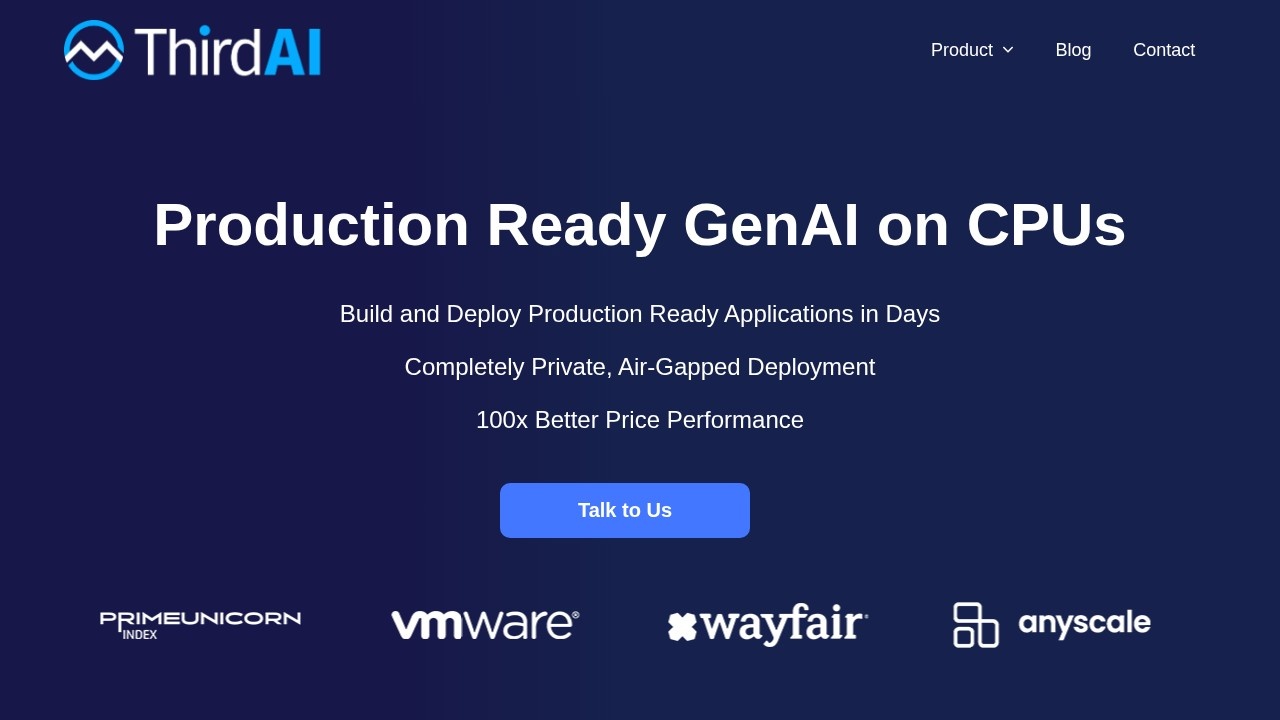
Pocket Llm is a tool built on the ThirdAI platform that lets you develop and deploy generative AI applications quickly and securely. It runs on standard CPU infrastructure, so you don't need specialized GPUs or complex deployment pipelines.
You begin by uploading or linking your data. The platform handles the heavy lifting of chunking, parsing, embedding, and vector storage, so the raw input can be a set of PDFs, CSVs, or unstructured text blocks. After ingestion, you select a built‑in model, such as a semantic search engine, a chatbot, or a document classification model, through its no‑code dashboard. The user interface lets you define prompts, set retrieval strategies, and adjust scoring weights. When you query the system, you supply a natural‑language question or command; the platform returns ranked results, extracted entities, or a generated response in a structured JSON format that you can embed directly in your application.
The tool is aimed at enterprises that need to innovate without the risk of an untested solution. It works best for teams with modest AI expertise because the platform hides the complexity of fine‑tuning, RLHF, and LLM guardrails. If your organization already has a solid data governance policy and requires air‑gapped hosting, the platform's on‑prem or VPC deployment options satisfy those constraints. It is less suitable for casual developers or hobby projects that prefer open‑source tooling, since pricing and licensing are not disclosed on the site.
Operationally, the platform claims inference latency of only a few milliseconds on CPUs, regardless of model size. This is achieved through a sparsity‐based architecture that mimics the brain's sparse connectivity. For training, the system can use AWS Graviton3‑based instances, offering up to a 30–40% performance boost and a 50% price‑performance improvement over comparable instances. The platform also supports enterprise single sign‑on and built‑in guardrails that filter out disallowed content at generation time. Feedback can be collected automatically from user interactions and fed back into the system for implicit fine‑tuning, allowing the model to improve over time without manual labeling.
Key features
- Production‑ready GenAI on CPUs, no GPU requirement
- No‑code interface with built‑in models for search, chat, and NLP tasks
- Enterprise single sign‑on and LLM guardrails for security and compliance
- Air‑Gapped deployment on cloud, on‑prem, or edge
- Implicit feedback and RLHF to refine models over time
Details
- Pricing
- Free
- Release date
- 2025-07-23
- Last checked
- 1h ago
- Indexing
- noindex, follow
- Category
- Code
Suggest an edit
Sign in to suggest an edit.
Pros and cons
Pros
- Runs entirely on CPUs, reducing hardware cost
- Rapid prototype to production timeline
- Embedded security features and private deployment support
- No‑code interface lowers technical barrier
- Built‑in models for common enterprise use cases
Cons
- No publicly listed pricing information
- Limited detail on supported model sizes and storage limits
- Reliance on enterprise workloads may require additional infrastructure planning
- Integration with external libraries described as “all‑in‑one,” but specifics not provided
Alternatives
 CerebriumIt is a practical choice for ai coding work, and the honest way to evaluate it is to give it a spin. Start at cerebrium.ai for the latest information. The...
 Fireworks AIYou are not locked into a single way of doing things. Fireworks AI supports your existing habits instead of forcing a new one, which makes adoption within a team much...
 Qdrant IoThere is a deliberate calm to how Qdrant Io works. Loading screens are short, buttons do what they say, and your work is saved where you expect it to be....
 LitellmThe tool has been refined through real use. Settings, history, and templates are organized so repeat work takes less effort each time. Litellm brings a fresh take on ai education...
 Lamatic AILamatic AI is a focused ai coding solution that answers a clear need. You can see what it does within minutes of opening the page. Power users get deeper controls,...
 Sourcery SentinelWhat stands out most is predictability. The same input produces dependable output, which matters when you are producing work for clients or publishing on a schedule. Sourcery Sentinel brings a...
 MarsaiPower users get deeper controls, while casual users can ignore them. The result is a tool that scales from quick one-off tasks to larger recurring workloads. You will find a...
 CosineCosine brings a fresh take on ai coding tools, pairing powerful AI with an interface that does not get in the way. It is aimed at everyday users and professionals...
 Dot SymbolCopy dot symbols and check their Unicode, HTML, CSS, JavaScript, and keyboard references.
 ScrapingdogBuilt for ai coding work, Scrapingdog combines capable AI with straightforward design. It is the kind of tool you can start using immediately. Freelancers use it to keep client work...
 LovableLovable builds and hosts full web apps from a chat, with Cloud hosting, auth and payments included and a credit-based Pro and Business plan.
 Maxim AIWhat stands out most is predictability. The same input produces dependable output, which matters when you are producing work for clients or publishing on a schedule. Away from the main...