


Fireworks AI
You are not locked into a single way of doing things. Fireworks AI supports your existing habits instead of forcing a new one, which makes adoption within a team much...
Sign in to rate this tool.
Overview
Fireworks AI is an infrastructure platform for building with open AI models. It covers both training and inference, with the aim of letting companies turn leading open models and their own data into specialised models they control. Fireworks says it was founded by the creators of PyTorch, and its CEO is Lin Qiao.
Training
Fireworks offers several ways to train or customise a model, depending on how mature your workload is. In a guided path, you describe the task, review the plan and cost, approve the run and receive a trained model. In a configuration-led approach, you choose the model, data and method, and Fireworks handles scheduling, training and the handoff to production. For advanced teams, you can write your own training logic, including your own loss function, trainer and reinforcement learning loop, running on Fireworks GPUs with rollout serving and weight synchronisation. Each checkpoint can be deployed to production in seconds.
Inference
Fireworks serves the latest open models, or your own trained versions, from development scale up to very large production workloads.
Fireworks Nexus
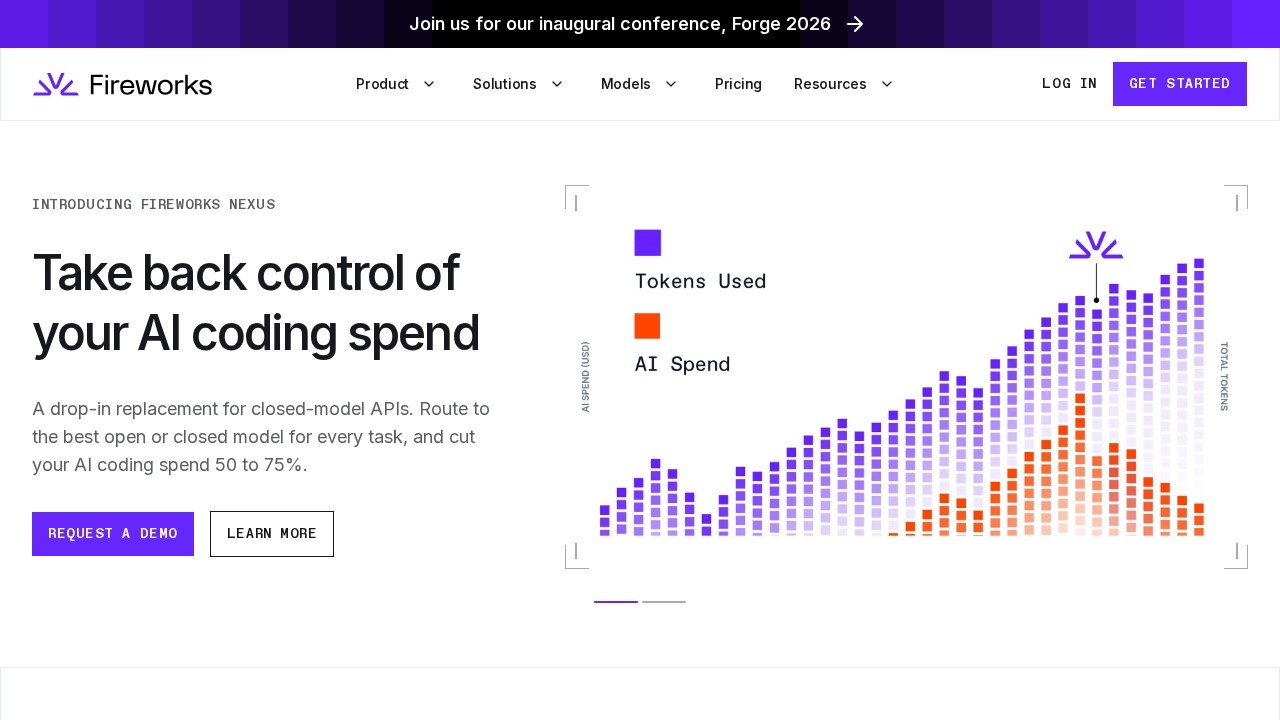
Nexus is a newer product described as a drop-in replacement for closed-model APIs. It routes each task to the best open or closed model, and Fireworks claims it can cut AI coding spend by 50 to 75%. That is the company's own estimate.
Pricing
Serverless inference uses per-token pricing with pre-paid, usage-based billing, zero setup and no cold starts. Training lets you customise open models with your own data, with its own price list. On-demand deployments are billed per GPU second for faster speeds, higher rate limits and lower costs at scale. Enterprise deployments with custom terms are available through sales.
Who it suits
It suits AI engineering teams that want to run open models in production, fine-tune them on their own data, or reduce reliance on closed-model APIs.
Things to consider
Per-token and per-GPU-second billing can rise quickly under heavy load, so set budgets and monitor usage. Check each open model's licence for commercial use. Before sending sensitive data for training, review data retention and security terms.
Teams can start on shared serverless endpoints while prototyping and later move to dedicated deployments or custom-trained models as traffic and quality requirements grow.
Details
- Pricing
- Paid
- Release date
- 2025-06-20
- Last checked
- 4d ago
- Indexing
- index, follow
- Category
- Code
Suggest an edit
Sign in to suggest an edit.
Alternatives
 DynamiqYou are not locked into a single way of doing things. Dynamiq supports your existing habits instead of forcing a new one, which makes adoption within a team much smoother....
 Api Governance TestingApi Governance Testing brings a fresh take on ai coding tools, pairing powerful AI with an interface that does not get in the way. It is aimed at everyday users...
 ReplitReplit is a browser-based builder where an AI Agent writes, hosts and publishes full apps from a plain-language description, with database and auth built in.
 Lamatic AILamatic AI is a focused ai coding solution that answers a clear need. You can see what it does within minutes of opening the page. Power users get deeper controls,...
 CruderraIt is a practical choice for ai coding work, and the honest way to evaluate it is to give it a spin. Start at cruderra.com for the latest information. If...
 Webo AIFreelancers use it to keep client work moving, while in-house teams rely on it for consistent output across projects. Either way, the routine parts of ai image generation work get...
 LitellmThe tool has been refined through real use. Settings, history, and templates are organized so repeat work takes less effort each time. Litellm brings a fresh take on ai education...
 LovableLovable builds and hosts full web apps from a chat, with Cloud hosting, auth and payments included and a credit-based Pro and Business plan.
 Qdrant IoThere is a deliberate calm to how Qdrant Io works. Loading screens are short, buttons do what they say, and your work is saved where you expect it to be....
 CosineCosine brings a fresh take on ai coding tools, pairing powerful AI with an interface that does not get in the way. It is aimed at everyday users and professionals...
 CodefastAccording to its listing, Codefast is an AI tool in the ai...
 MarsaiPower users get deeper controls, while casual users can ignore them. The result is a tool that scales from quick one-off tasks to larger recurring workloads. You will find a...