


Mercury 3
The diffusion LLM that scaled 40x without slowing down
Sign in to rate this tool.
Overview
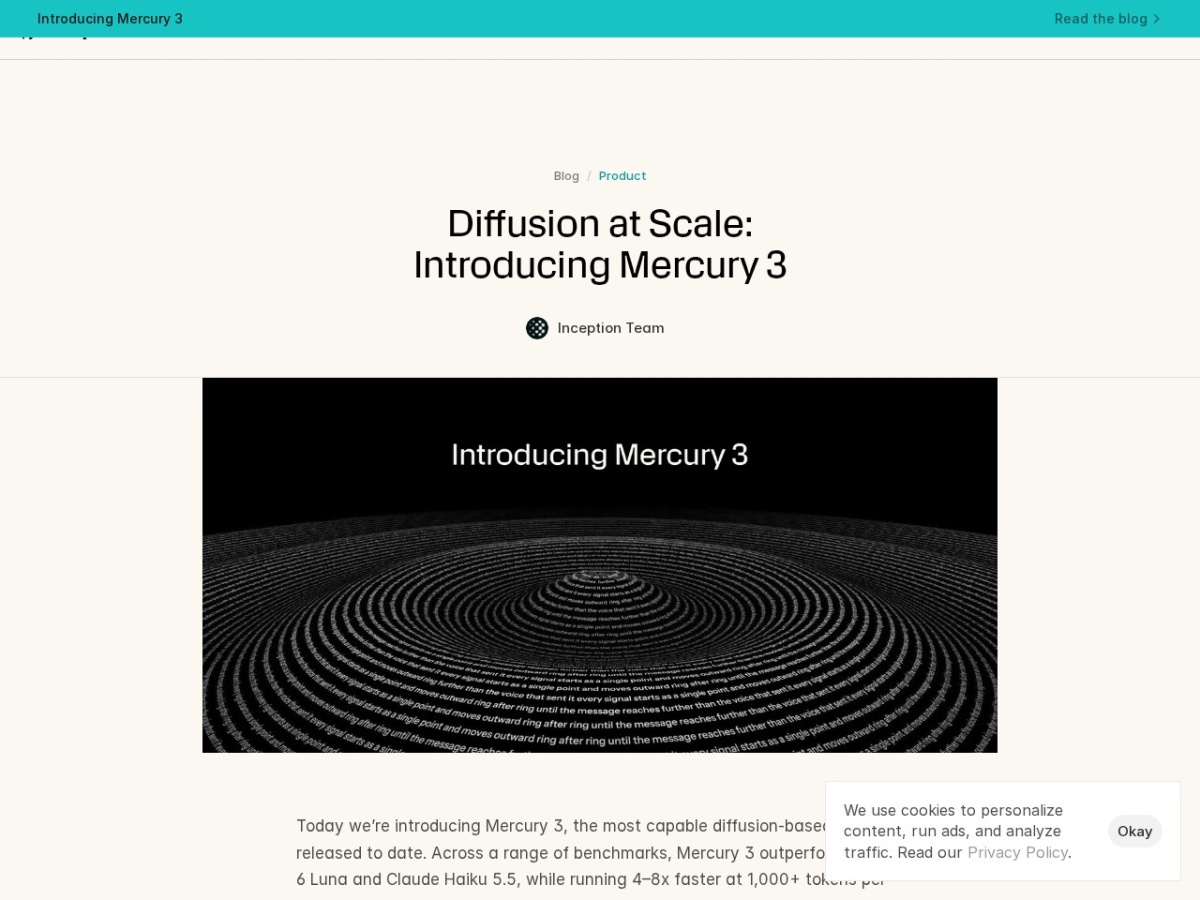
Mercury 3 is a diffusion‐based large language model from Inception Labs that pushes the upper limits of speed and context size. The model is marketed as surpassing GPT‑6 Luna and Claude Haiku 5.5 on a range of benchmarks while delivering 1 000+ tokens per second. It is 40× larger in total parameters than the original Mercury 1, yet remains fast and can process over 1 million tokens of context.
Typical users are developers building latency‑sensitive tools: real‑time voice assistants, interactive tutoring systems, web‑navigation agents, and search or support chatbots. In each scenario the model receives a prompt that can be up to 1 million tokens—such as a full web page, a transcript of a dialogue, or a batch of documents—and returns a completion that typically stays within the same token count as the input. In practice, a tutor bot can analyze a student’s typed answer, generate hints, and respond in about a second, while a search agent can parse dozens of passages and return a concise answer to a user within 2 seconds. Access partners have seen the model complete 50 percent of 50 live navigation tasks against frontier models, using equal token budgets and a similar number of agent steps but at a fraction of the per‑token cost.
The pricing model offers $0.20 per million input tokens and $0.70 per million output tokens, with a launch discount of 50 percent ($0.10 input, $0.35 output). Cached tokens cost 90 percent less, which is useful for maintaining session‑level context across repeated calls. The listing does not disclose the API endpoints, SDKs, or supported host platforms—only mentions that the model runs on NVIDIA GPUs. It also does not specify any usage limits beyond the token rates or provide evidence of billing or license terms for production environments.
Because the description concentrates on speed, context, and cost, it is most suitable for applications that need to pull long documents into a single inference and respond quickly, such as AI tutors and search agents. It may be less relevant for workloads that require ultra‑low network round‑trip times, as there is no mention of deployment in edge or on‑premise environments, nor of specific latency targets beyond the per‑token rate.
Key features
- 1 million‑token context window, surpassing 260 000 tokens of earlier versions
Details
- Pricing
- Free
- Last checked
- 15h ago
- Indexing
- noindex, follow
Suggest an edit
Sign in to suggest an edit.
Pros and cons
Pros
- Extremely fast token throughput for high‑volume interactions
- Large context area enables full‑document processing in a single call
- Discounted pricing makes it cost‑effective for both input and output tokens
Cons
- No API or deployment details provided in the listing text
- Limited information on supported hardware beyond NVIDIA GPUs
- Lack of explicit latency metrics for end‑to‑end user experience.
Alternatives
 Featherless LlmBefore you decide, skip the speculation and look at the source. featherless.ai shows exactly what Featherless Llm does today and how to get started with it. Featherless Llm brings a...
 Modal ComRather than chasing every possible feature, Modal Com picks the ones that matter and does them well. That restraint is noticeable the first time you open it. Freelancers use it...
 Gpt TranslatorAI-powered translation platform using GPT technology for accurate and instant translations.
 GemmaGemma is Google DeepMind's family of open-weight models, from phone-sized E2B and E4B up to 31B, plus variants for embeddings, translation and health.
 DeepSeekDeepSeek is a China-based AI lab with a chat assistant (no advertised subscription) and a low-cost developer API offering a reasoning mode and a 1M-token context window.
 Tolgee AI TranslatorTolgee AI Translator is a ai writing assistant that focuses on one thing: making the work easier. It skips unnecessary clutter and gets straight to useful output. There is a...
 GowhisperPrivacy-focused desktop app for local audio transcription.
 DALL-E 3DALL·E in ChatGPT review (October 2026): DALL·E is retired; what ChatGPT Images now offers, plan access, pricing, pros, cons and alternatives.
 CerebriumIt is a practical choice for ai coding work, and the honest way to evaluate it is to give it a spin. Start at cerebrium.ai for the latest information. The...
 Meta AIMeta AI is Meta's free assistant inside WhatsApp, Instagram, Messenger and Facebook, with deep research, image editing and voice in 13 languages.
 PixMindThe tool may appeal to individuals and teams looking for help with...
 TavilyThe feature set covers the basics well and adds thoughtful extras - keyboard shortcuts, reusable templates, and clean sharing options - without overwhelming you. Freelancers use it to keep client...