


Modal Com
Rather than chasing every possible feature, Modal Com picks the ones that matter and does them well. That restraint is noticeable the first time you open it. Freelancers use it...
Sign in to rate this tool.
Overview
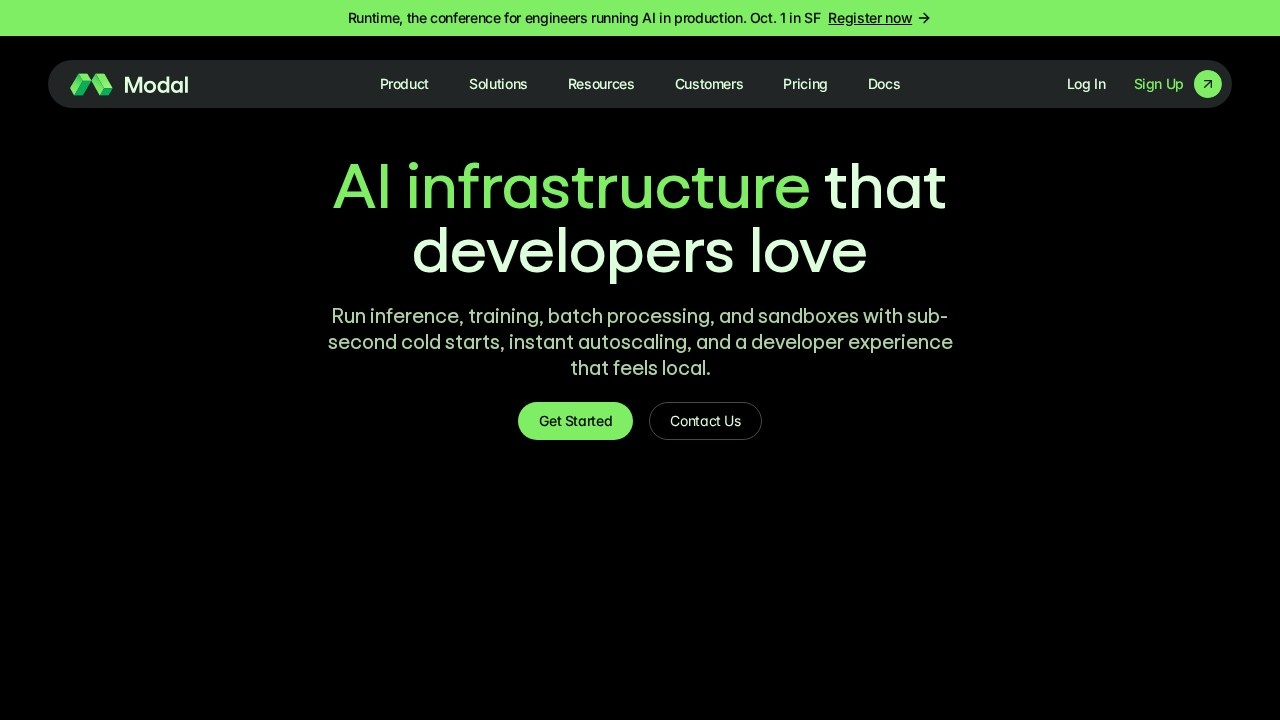
Modal is cloud infrastructure for teams that develop, train and serve AI applications. Developers define their code and its environment in Python, and Modal runs it on CPUs or GPUs that spin up in seconds, scaling up and down with demand. The company has announced a Series D funding round and says it has passed $1 billion in annualised revenue run rate.
Products
Modal Inference serves large language models and image, video and audio models, from real-time endpoints to large batch jobs. Sandboxes provide isolated environments for coding agents, reinforcement learning rollouts and untrusted code, and the company has written about scaling to one million concurrent sandboxes. Training lets teams fine-tune models, run reinforcement learning and evaluate models on GPUs without managing clusters. Underneath, Modal says it has rebuilt infrastructure for AI, including its own container runtime, storage and a multi-cloud pool of GPU capacity.
Developer tools
A browser playground lets you try Modal without installing anything. The site also offers a GPU Glossary explaining GPU concepts and an LLM Engine Advisor to help choose a model and serving engine. There is a changelog, a blog, a Slack community and startup credits for eligible companies.
Pricing
Modal charges per second for GPU and CPU usage, so you pay only while code is running rather than for idle servers. Free starting credits are typically offered on sign-up, and enterprise plans are available through sales. Check the pricing page for current GPU rates.
Who it suits
Modal suits machine learning engineers, AI startups and product teams that want to deploy models or run GPU workloads without operating Kubernetes or reserving servers, and agent builders who need safe code execution.
Things to consider
Per-second billing is efficient for bursty workloads, but steady high-volume use can cost more than reserved capacity, so model your expected spend. Cold starts are fast but not zero, which matters for latency-sensitive apps. Review data residency and security options if you handle sensitive data, and set spending limits while you experiment.
Moving code to Modal usually involves adding decorators and environment definitions, so existing Python projects can often be migrated incrementally.
Details
- Pricing
- Paid
- Release date
- 2026-04-03
- Last checked
- 3d ago
- Indexing
- index, follow
- Category
- Development
Suggest an edit
Sign in to suggest an edit.
Alternatives
 AdminforthPricing model listed: free. Pricing and...
 Featherless LlmBefore you decide, skip the speculation and look at the source. featherless.ai shows exactly what Featherless Llm does today and how to get started with it. Featherless Llm brings a...
 OpensilverAccording to its listing, Opensilver is an AI tool...
 Maxim AIWhat stands out most is predictability. The same input produces dependable output, which matters when you are producing work for clients or publishing on a schedule. Away from the main...
 Fluxai Art Free AI Image GeneratorRather than chasing every possible feature, Fluxai Art Free AI Image Generator picks the ones that matter and does them well. That restraint is noticeable the first time you open...
 Js2tsRather than chasing every possible feature, Js2ts picks the ones that matter and does them well. That restraint is noticeable the first time you open it. For a straightforward look...
 Becc AIAI-powered LinkedIn content creation tool for freelancers and professionals.
 FixkeyAI writing assistant for Mac that adapts to your style.
 Proposal GenieProposal Genie is a focused ai design solution that answers a clear need. You can see what it does within minutes of opening the page. Small operations appreciate the low...
 Tolgee AI TranslatorTolgee AI Translator is a ai writing assistant that focuses on one thing: making the work easier. It skips unnecessary clutter and gets straight to useful output. There is a...
 Trinka AI Grammar Checker ToolIf ai writing tasks take up too much of your day, Trinka AI Grammar Checker Tool is built to give you time back. It handles the heavy lifting while leaving...
 Plan Quest BetaIt is a practical choice for ai writing work, and the honest way to evaluate it is to give it a spin. Start at plans.quest for the latest information. Plan...