


Sign in to rate this tool.
Overview
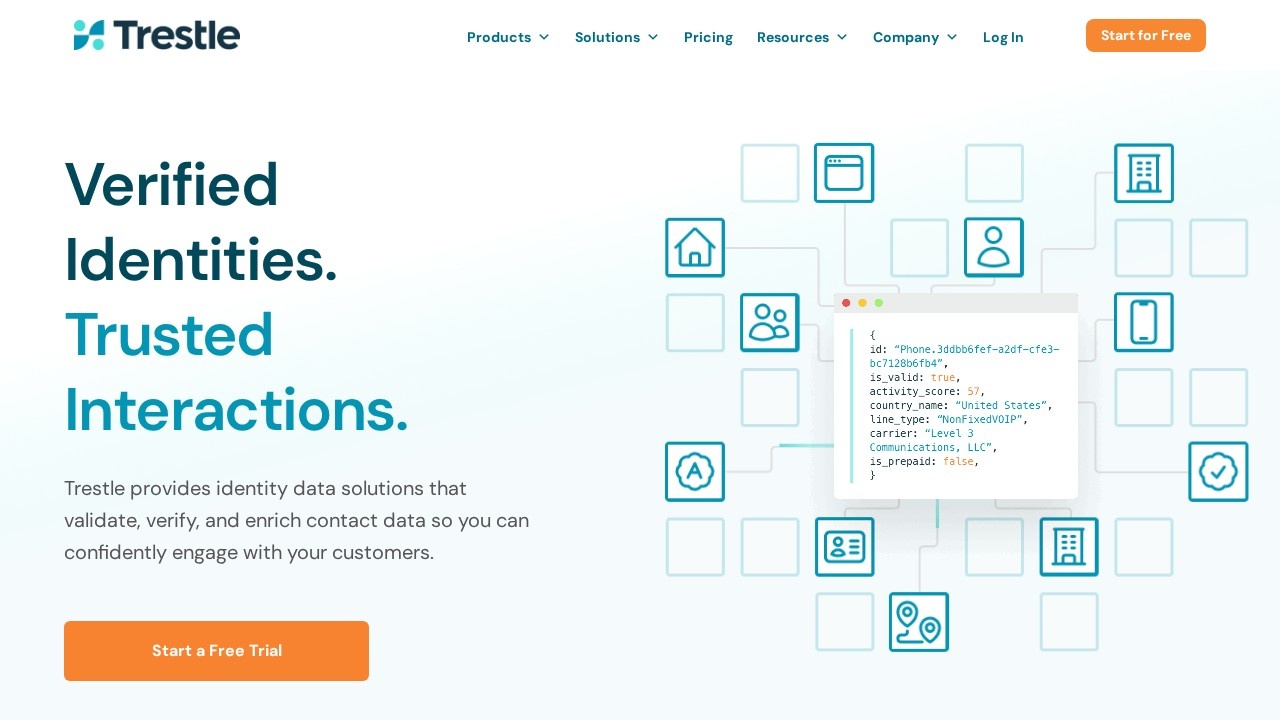
Trestle offers identity data enrichment and validation APIs that let developers incorporate verification into their software. The website shows a REST interface that accepts common identity fields and returns structured results. The service is aimed at teams that need to clean or confirm personal information before using it in marketing, compliance, or fraud‑prevention contexts.
The API works by sending a POST request with a JSON body that lists the attributes you want checked. Typical inputs include “first_name”, “last_name”, “email”, “phone”, “address”, and “national_id”. The server responds with a JSON object that echoes the input, attaches a confidence score for each attribute, and adds any additional data it found in public databases, such as corrected street names or matched records. For example, if you send an address that is slightly misspelled, the response may include a standardized version and a score indicating how likely it matches a real location. The platform also offers a batch endpoint in which you can upload up to 1,000 individual records in one call. The batch response contains the same enriched data for each record, enabling you to process large lists without numerous round‑trips.
Trestle is suited for organizations that handle large volumes of personal data and must ensure accuracy before data leaves their system. Marketing teams can use it to improve deliverability, compliance officers can verify identity for KYC checks, and e‑commerce platforms can prevent fraudulent orders. Because the API is stateless and returns data in JSON, it can be plugged into existing ETL pipelines, serverless functions, or backend microservices with minimal fuss. The service does not provide a user interface; you rely on your own front‑end or integration layer to call the endpoints. The listing does not disclose pricing, API key management, rate limits, or error codes, so further investigation or contact may be needed to set up a production environment.
Key features
- POST endpoint that accepts JSON with identity fields
- Confidence scoring for each validated attribute
- Automatic correction suggestions for common errors
- Batch processing: up to 1,000 records per request
- JSON output containing original and enriched data
- Stateless API suitable for integration into pipelines
Details
- Pricing
- Free
- Release date
- 2026-04-02
- Last checked
- 1h ago
- Indexing
- noindex, follow
- Category
- Code
Suggest an edit
Sign in to suggest an edit.
Pros and cons
Pros
- Handles common identity fields needed for verification
- Batch capability improves throughput for large data sets
- JSON format simplifies parsing across languages
- No need to host or maintain validation logic locally
Cons
- Pricing information is not listed on the public site
- Authentication method is not detailed; key management unclear
- Limited disclosure of error handling and rate‑limit policies
- No user interface; integration must be handled by developers
Alternatives
 ScrapingdogBuilt for ai coding work, Scrapingdog combines capable AI with straightforward design. It is the kind of tool you can start using immediately. Freelancers use it to keep client work...
 Veryfi ComIf ai coding tasks are part of your routine, Veryfi Com is worth testing against your own use cases. Their website, veryfi.com, has the full details. Small operations appreciate the...
 AgentqlBuilt for ai agents work, Agentql combines capable AI with straightforward design. It is the kind of tool you can start using immediately. Rather than chasing every possible feature, Agentql...
 Faraday AIPower users get deeper controls, while casual users can ignore them. The result is a tool that scales from quick one-off tasks to larger recurring workloads. It runs on a...
 MacgptSmall operations appreciate the low setup cost, and larger teams value the consistency. Both end up spending less time on busywork and more on the actual result. Plenty of detail...
 ChatboxPower users get deeper controls, while casual users can ignore them. The result is a tool that scales from quick one-off tasks to larger recurring workloads. The tool is free,...
 Fireworks AIYou are not locked into a single way of doing things. Fireworks AI supports your existing habits instead of forcing a new one, which makes adoption within a team much...
 WarpWarp pairs a modern terminal with coding agents and cloud agent fleets, with usage included at API rates on its Build, Max and Business plans.
 Dhtmlx ChatbotThe tool is free, which keeps the barrier to entry low. You can try it before deciding whether it earns a permanent place in your workflow. For a straightforward look...
 Dot SymbolCopy dot symbols and check their Unicode, HTML, CSS, JavaScript, and keyboard references.
 AI Profile For SlackPricing is free, and there is no pressure to commit before you have seen results in your own context. A few standout features include quick presets, template support, export in...
 CodefastAccording to its listing, Codefast is an AI tool in the ai...